On this page
If your training record only counted the courses you ran yourself, it would look tidy and still be wrong. A meaningful share of the learning your regulated and professional staff do happens somewhere else: an exam sat at a professional body, a seminar, an industry conference, a webinar, a course delivered by an external provider. Those activities create CPD/CPT hours exactly the way in-house courses do, but almost none of their evidence starts life in your systems. The practical answer is to stop treating outside learning as out of scope and start treating each activity as a managed claim — submitted, reviewed, credited and reported through the same account as everything else.
Written for compliance, HR and L&D leads in Hong Kong organisations whose people hold licences or professional memberships with CPD/CPT requirements. The mechanism is general; where a regulator or professional body sets specific hour rules for your people, this is how those hours become provable.
The gap auditors find first
There is a belief worth naming: that external training is “outside the system”, so it is not the learning platform’s problem. The belief survives because it feels true — nobody enrolled those people in the platform, nobody ran the course, and the certificate went to the employee, not to the training team.
From the learner’s perspective, though, nothing about those hours is external. A CPD/CPT hour earned at a conference counts toward the same total as an hour earned in an in-house module, and the total is what a reviewer eventually asks to see. When a sample is pulled — at an audit, a licence renewal or an internal review — the external half of the record is usually where the mismatches surface first: a claim with no certificate attached, dates that fall outside the period, hours that appear nowhere except in a personal spreadsheet rebuilt every renewal season.
That last one deserves attention, because it shows what the problem actually costs. If an employee’s outside learning exists only as a shoebox of certificates and a spreadsheet the employee maintains, then the organisation does not really hold the record — the employee does. When the employee leaves, goes on leave or simply loses the folder, the hours become unreconstructable exactly when someone asks for them.
What counts as outside learning
It is more than courses. Professional bodies are explicit that development does not come only from formal, course-based learning: the CIPD describes CPD as anything that helps a professional develop and improve their practice, from a course to a conversation, a podcast or an event, and treats recording that learning as a routine part of membership rather than an optional extra. The practical consequence for employers is simple: the broader the definition your people’s bodies use, the more learning happens outside your enrolment process, and the less you can close the gap by scheduling more in-house courses.
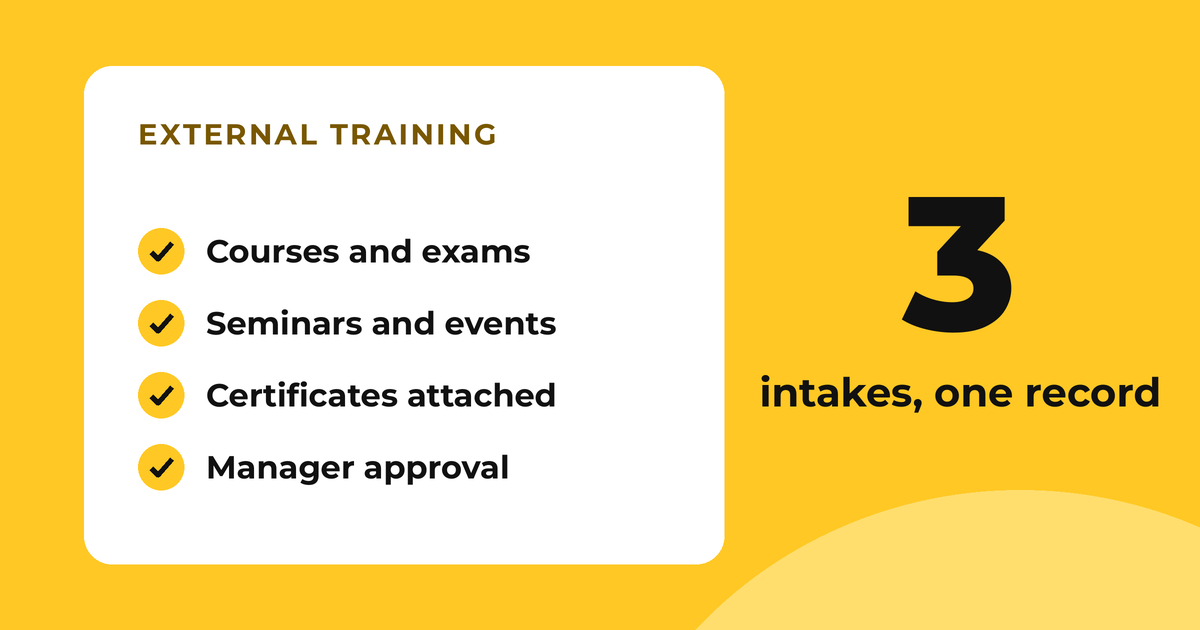
Which external activities matter most varies by workforce. For licensed professionals it is exams, accredited courses and structured seminars that carry claimable hours. For managers and technical staff it is often conferences, industry briefings and externally delivered workshops that matter to the role even where no hours are attached. Designing the intake around only one of those shapes loses the other.
The life of a claim
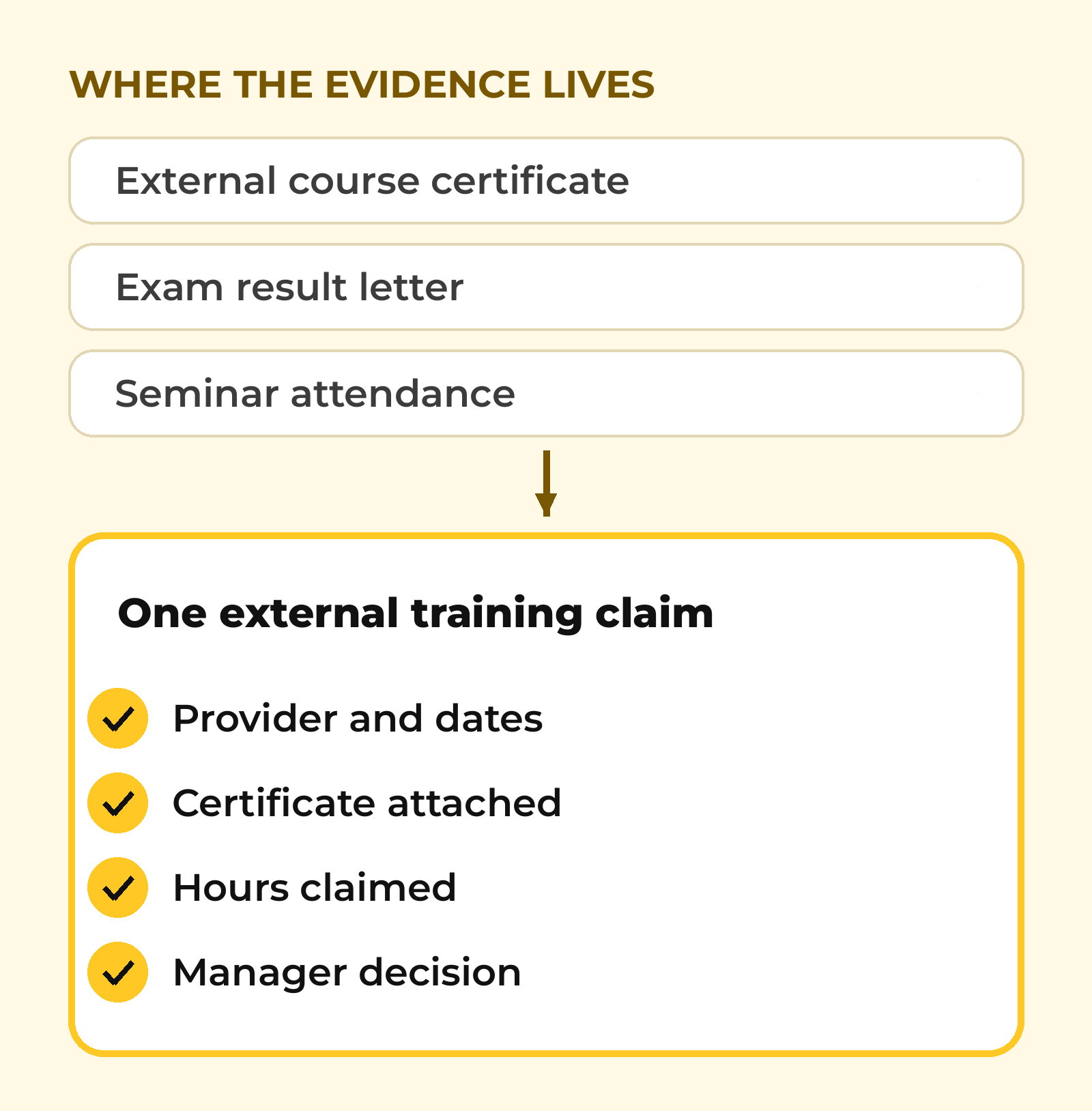
The workable pattern is to give every external activity the same life: the employee submits what they attended — the provider, the dates, the certificate and the CPD/CPT hours they wish to claim; their line manager reviews it; the claim is approved with a comment or rejected with a reason; a rejected claim can be corrected and resubmitted; approved hours join the learner’s record; and the totals show up in the same reports as in-house learning. UpLearn is designed to support exactly this loop: employees can submit externally attended training with supporting certificates and the hours they wish to claim, the request goes to their line manager for approval with comments, and a rejected submission can be corrected and resubmitted.
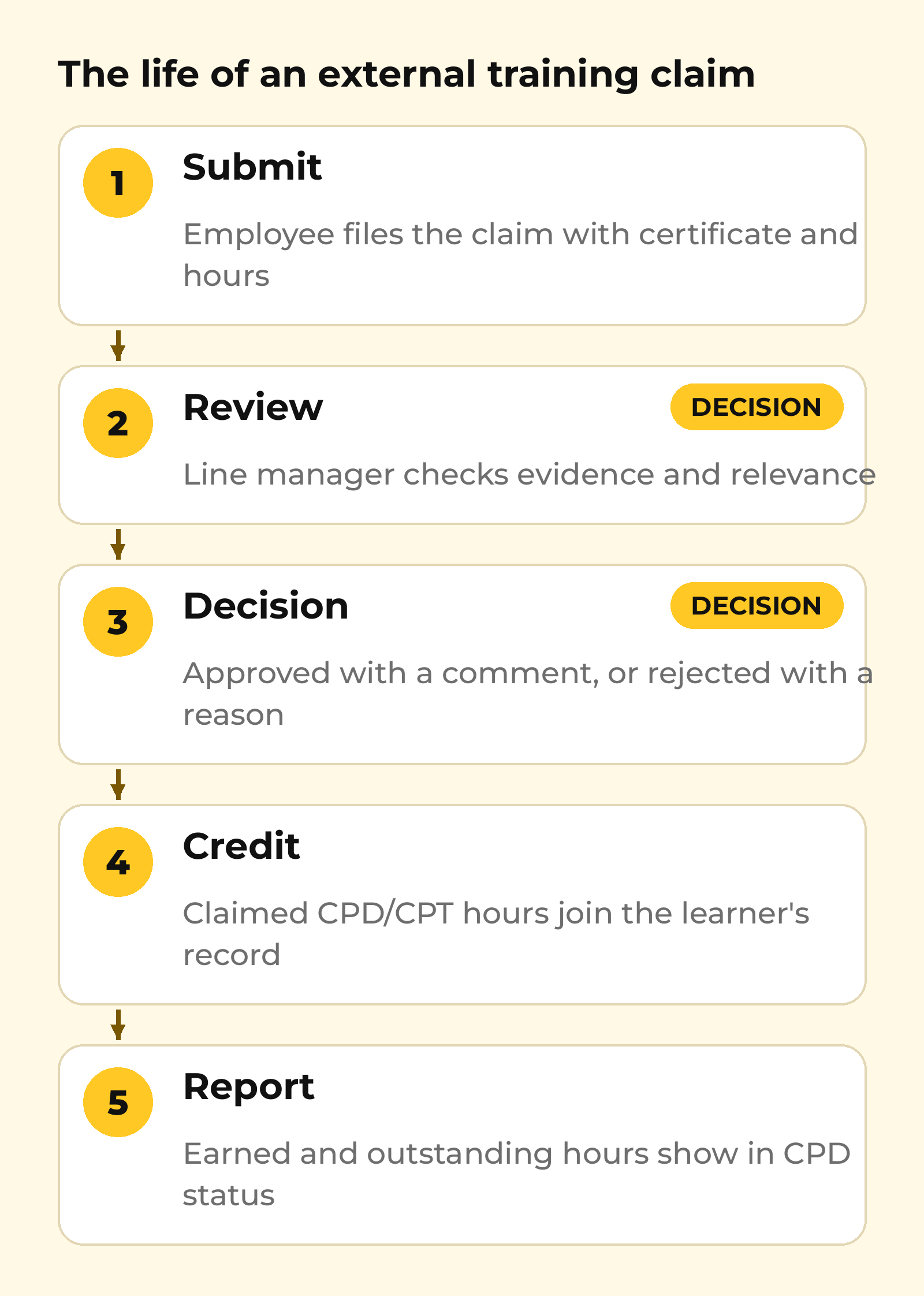
Two things in that sequence do more work than they look like they do. First, the rejection path is a feature, not friction: a claim rejected with a written reason, corrected and resubmitted, leaves behind a trail that shows the control actually operated. A process where every claim is approved instantly is either suspiciously clean or nobody is reading them. Second, the claim carries its evidence with it — the certificate and the claimed hours travel together, which is precisely the pairing that goes missing when evidence lives in a drawer.
What the approver is actually approving
It is worth being honest about the approval step, because it is often dismissed as an administrative tick. The manager is not confirming that the employee attended a course. They are attesting three things at once: that the activity is relevant to the person’s role, that the certificate supports the hours being claimed, and that the dates fall inside the period the hours are meant to count for. Those are three different checks, and each one has a different failure mode — relevance fails quietly (everything looks plausible), dates fail loudly (the arithmetic is wrong), and certificate-to-hours mismatches fail only if someone opens the attachment.
Three habits make the approval worth having. Write the reason on a rejection, so the employee can fix the actual problem instead of guessing. Keep the approver’s remarks with the claim, so the decision is visible later without reconstructing it from memory. And decide in advance who approves when the line manager is the attendee — a claim the manager submits about their own external course should not be approved by themselves.
One account, not two
The claim process is one of several ways outside hours can arrive, and the design rule that matters most is that they all end in the same place. In-house courses that are linked to a licence credit their hours when someone completes the course. External claims arrive through the approval loop above. And hours that fit neither shape — a legacy record being carried into a new system, or a single event that a whole department attended — can be brought in as a bulk import, because hours earned outside the platform can be imported in bulk rather than being left on a spreadsheet.
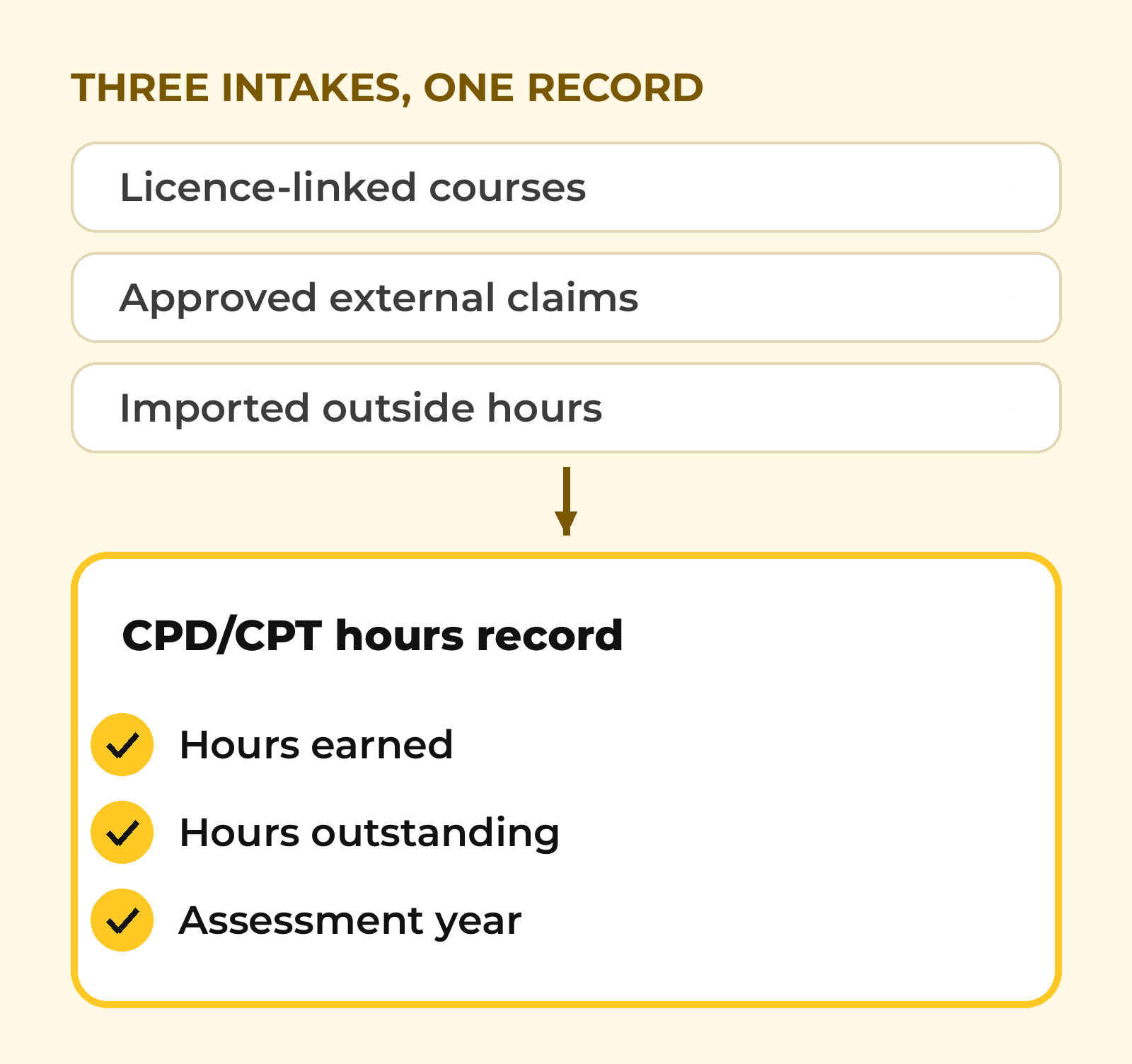
The reason single-account is a rule and not a preference is arithmetic. A person’s CPD/CPT position for a cycle is one number: hours earned against hours required. The moment that number is assembled from two ledgers, it starts to drift — the platform says one thing, the departmental spreadsheet says another, and the version that survives is whichever one the reviewer happens to be shown. CPD reports that show hours earned and outstanding per assessment year and licence, with personal records exportable as PDF, are what let the organisation, the manager and the employee all read from the same page without a reconciliation exercise first.
There is a quieter benefit too. When the record is in one account, the employee can see their own position — what they have earned, what they still owe — before the renewal deadline rather than after it. Most of the panic in the final weeks of a CPD cycle is not caused by a shortage of learning; it is caused by nobody being sure where the person stands.
Set the rules before the cycle ends
None of this is technically difficult, which is why it fails quietly instead: the claim form exists but nobody set what evidence is required; the approval exists but rejections come back with no reason; hours are credited, but from three different places. The moment to fix it is before the cycle ends, not during the renewal rush. Decide what evidence a claim must carry, who approves it and what happens when they disagree, how the hours map to licences, and which report you will actually read — then pick three people who attended something outside the organisation last quarter and trace their hours end to end. Wherever the trail breaks is your intake design. And where a regulator or professional body prescribes how its members’ hours must be evidenced, its own guidance wins — the employer-side mechanism above is what makes those hours producible on demand, not a substitute for the body’s rules.
Sources
Cyberwisdom Asia Ltd. is a Hong Kong provider of learning management systems, CPD compliance software and bespoke courseware, serving 800+ enterprise clients since 1999.
About Cyberwisdom