On this page
- Key takeaways
- The two numbers that moved, and who is actually reading them
- The cap is the most misread line in the guidance
- What “hours worked” means where the clock is hardest to read
- Where the evidence of a briefing actually has to come from
- Retraining decisions that follow from a rate change
- Before the next payroll cycle closes
- Sources
The two numbers that moved, and who is actually reading them
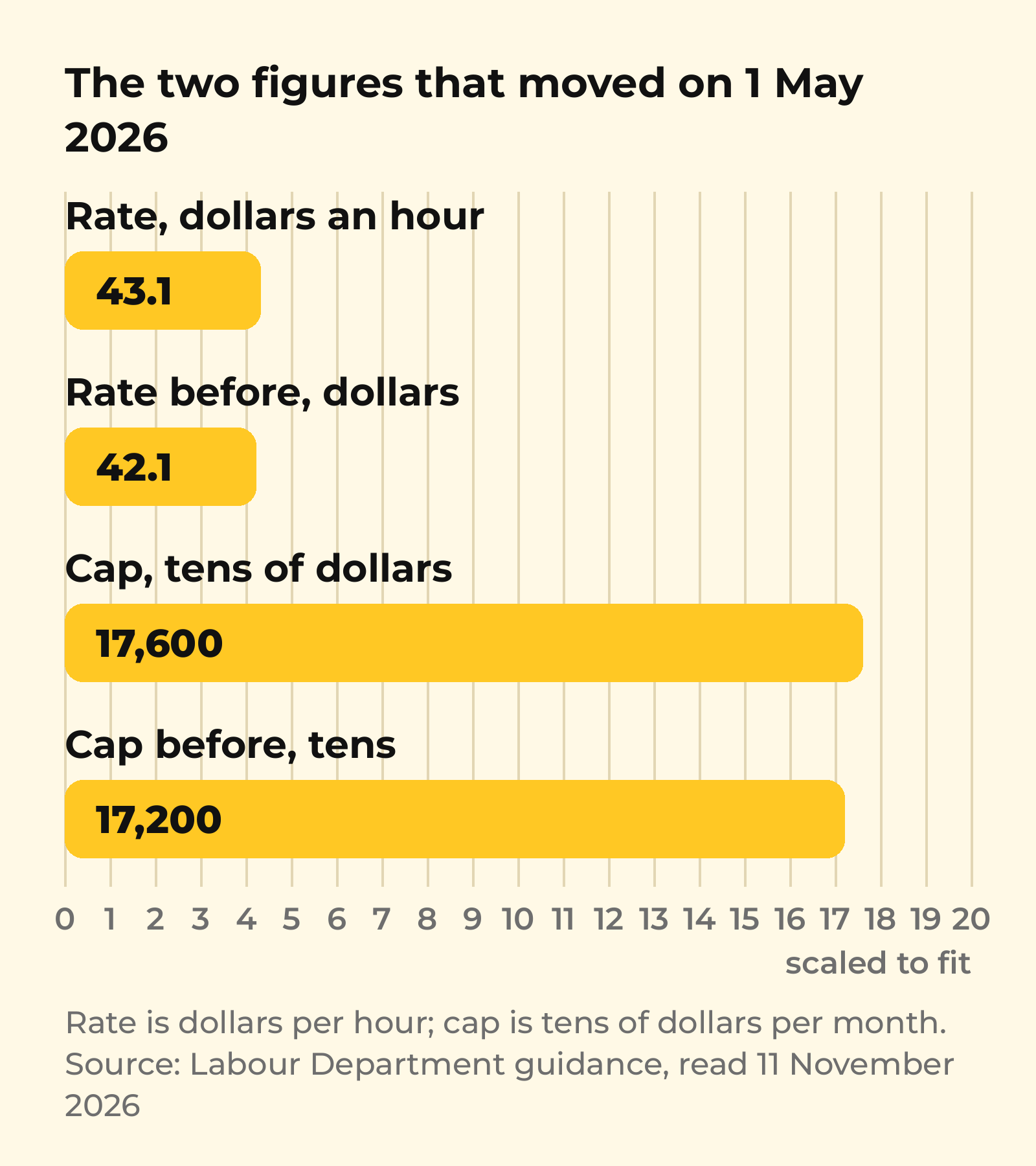
Two numbers, two units, and a habit in most organisations of treating both as a payroll department matter. The payroll department does not decide whether the quiet hour an officer spent waiting for a relief guard at the end of a shift counts. It gets told. The person who tells it, or who fills in the attendance sheet that tells it, is a supervisor with a rota, a WhatsApp group and a briefing they attended two or three years ago.
That is the gap worth naming precisely. The Ordinance sets a wage floor and a record-keeping duty. It does not prescribe who inside the company explains the floor to the people who apply it. In practice the explanation is delegated to a briefing, sometimes a fifteen-minute talk at the start of a shift, sometimes a slide deck handed down from a group HR function. When the rate changes, every one of those briefings becomes partially wrong at the same moment, and nobody is automatically told.
The cap is the most misread line in the guidance
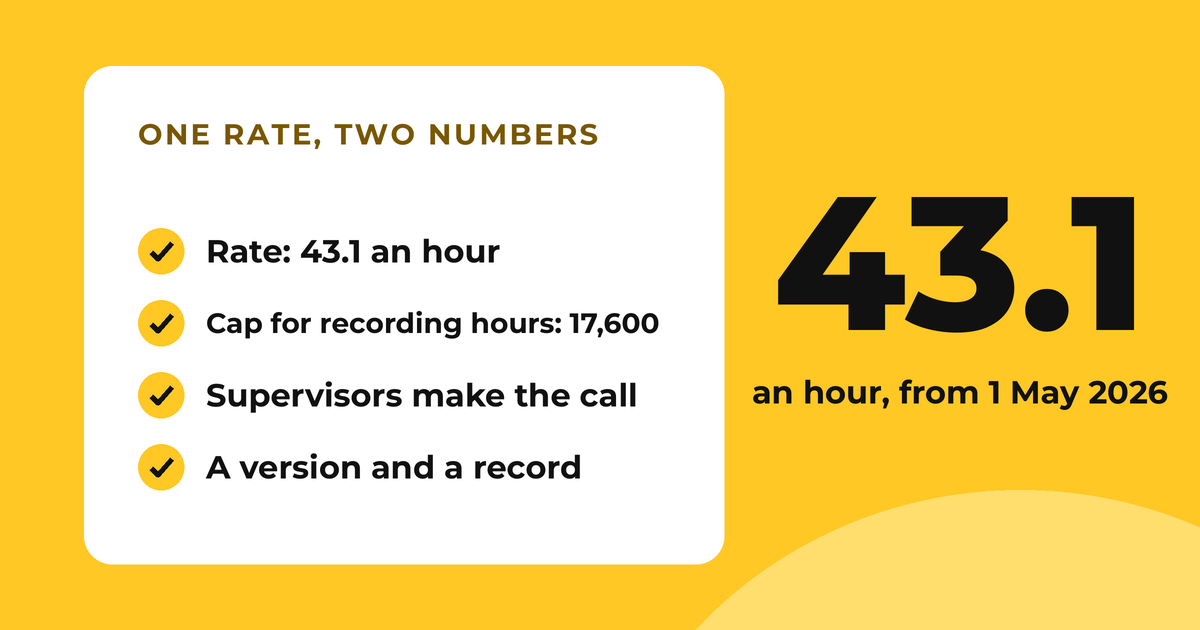
As with its predecessor, the $17,600 figure can be read as if it were a monthly minimum wage. The Labour Department answers that directly: the cap is only used to determine whether an employer is exempted from recording an employee’s total hours worked in a wage period, and it does not mean the monthly minimum wage rate is $17,600. An employer must pay not less than the minimum wage whether or not hours have to be recorded.
The distinction matters for training because the two numbers answer different questions, and a briefing that blurs them teaches a rule that will be applied wrongly in exactly the situation that matters: a part-time or shift worker whose monthly wage happens to sit above the cap. In that case the record-keeping duty may fall away, and the wage floor does not. A supervisor who has learned “above $17,600 means it is fine” has learned the opposite of what the guidance says.
Two further points in the guidance say the same thing about method. The Labour Department states that neither the Employment Ordinance nor the Minimum Wage Ordinance specifies how an employer records hours worked, and that employers and employees can draw up reasonable and practicable ways with regard to trade characteristics, nature of work and administrative measures. It also states that neither Ordinance specifies the format of the record. In other words, the method is the employer’s choice, which is convenient, and also the reason the method has to be written down somewhere a supervisor can apply it consistently. An unwritten method is not a policy; it is whatever the shift supervisor remembers.
What “hours worked” means where the clock is hardest to read
For a standard office role, hours worked is not a difficult question. For a guarding company, which we use here as an illustrative case, it is the whole question, because the nature of the job is presence rather than output.
The Labour Department’s guidance on hours worked is specific: hours worked include any time when the employee, in accordance with the contract, an agreement or the direction of the employer, is in attendance at a place of employment, whether or not the employee is provided with work or training at that time, and time travelling in connection with the employment, excluding the ordinary journey between home and the place of employment. Places of employment are defined around attendance for the purpose of doing work or receiving training.
Read against a guard’s night shift, that paragraph decides several arguments before they start. A quiet hour at the lobby post is hours worked. A handover period at the end of a shift is hours worked if the officer is required to be there. A training session on site is attendance for the purpose of receiving training. The journey from home to the post is not, unless the contract or agreement treats it as hours worked, in which case the guidance says the time must be included.
None of this is new law. What is new is that the multiplier in the calculation is now $43.1 rather than $42.1, and that the threshold at which the hours record is required is now $17,600 rather than $17,200. Worked examples in a supervisor briefing, laminated cards in a control room and e-learning screens built on the old figures are now calculating the wrong amount in a way that looks right.
The guidance also handles a detail that surprises people: part of an hour counts. The Labour Department states that the Ordinance does not require part of an hour to be rounded up to a whole hour; the actual period worked is used. Its own worked example takes 208.75 hours in a wage period and multiplies by $43.1 to reach $8,997.1. A briefing that teaches rounding to the nearest half hour has taught a rule the Ordinance does not contain.
Where the evidence of a briefing actually has to come from
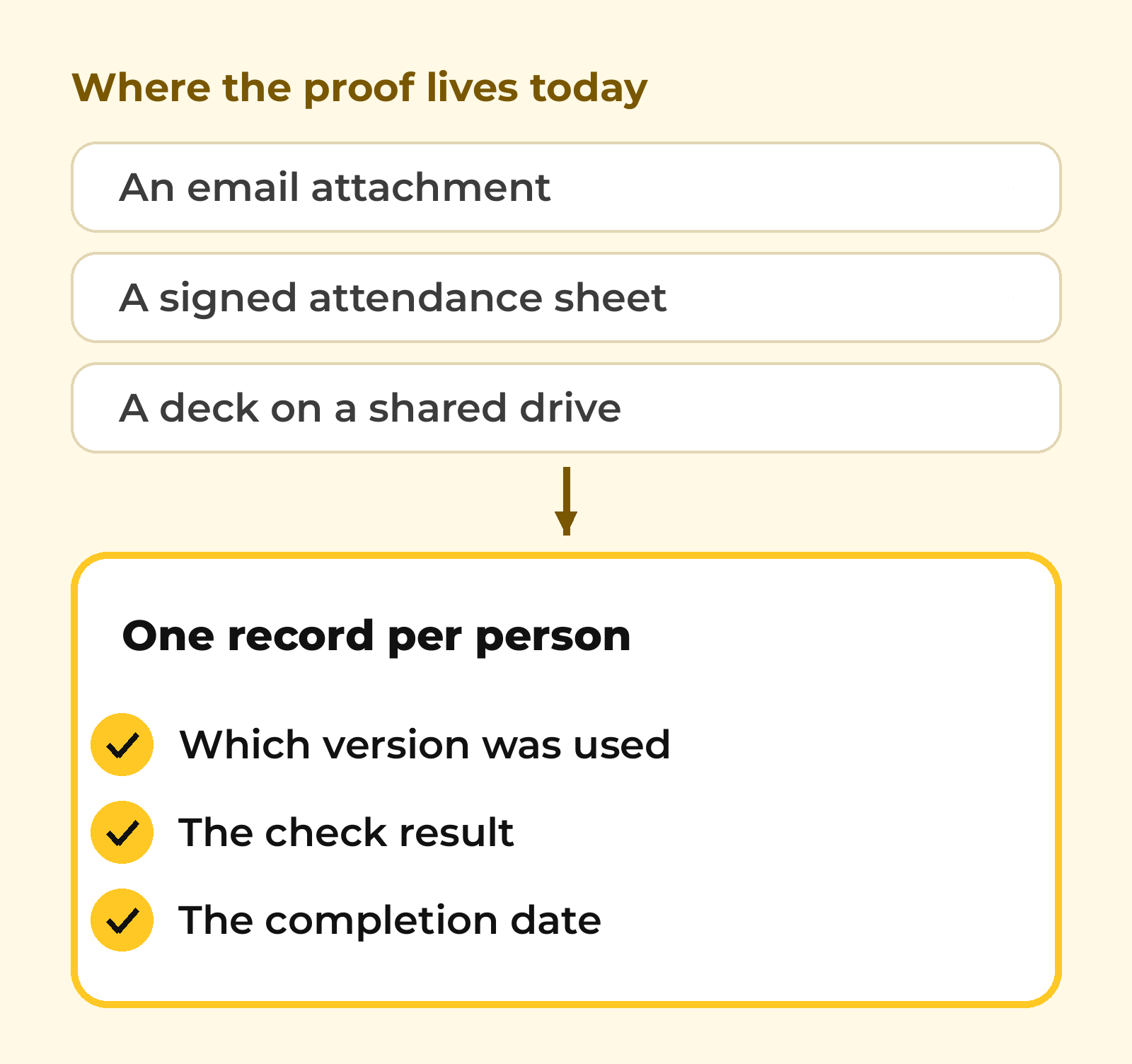
Take a hypothetical group that re-briefed everyone in the week after 1 May: it has done the right thing and can often prove very little of it. Today the proof is usually scattered: a deck on a shared drive, a PDF sent as an email attachment, a signed attendance sheet, a recorded webinar. The evidence that is hard to produce, and the kind an internal reviewer is likely to ask for, is per person: who attended, on which version, and whether they could apply the two figures afterwards.
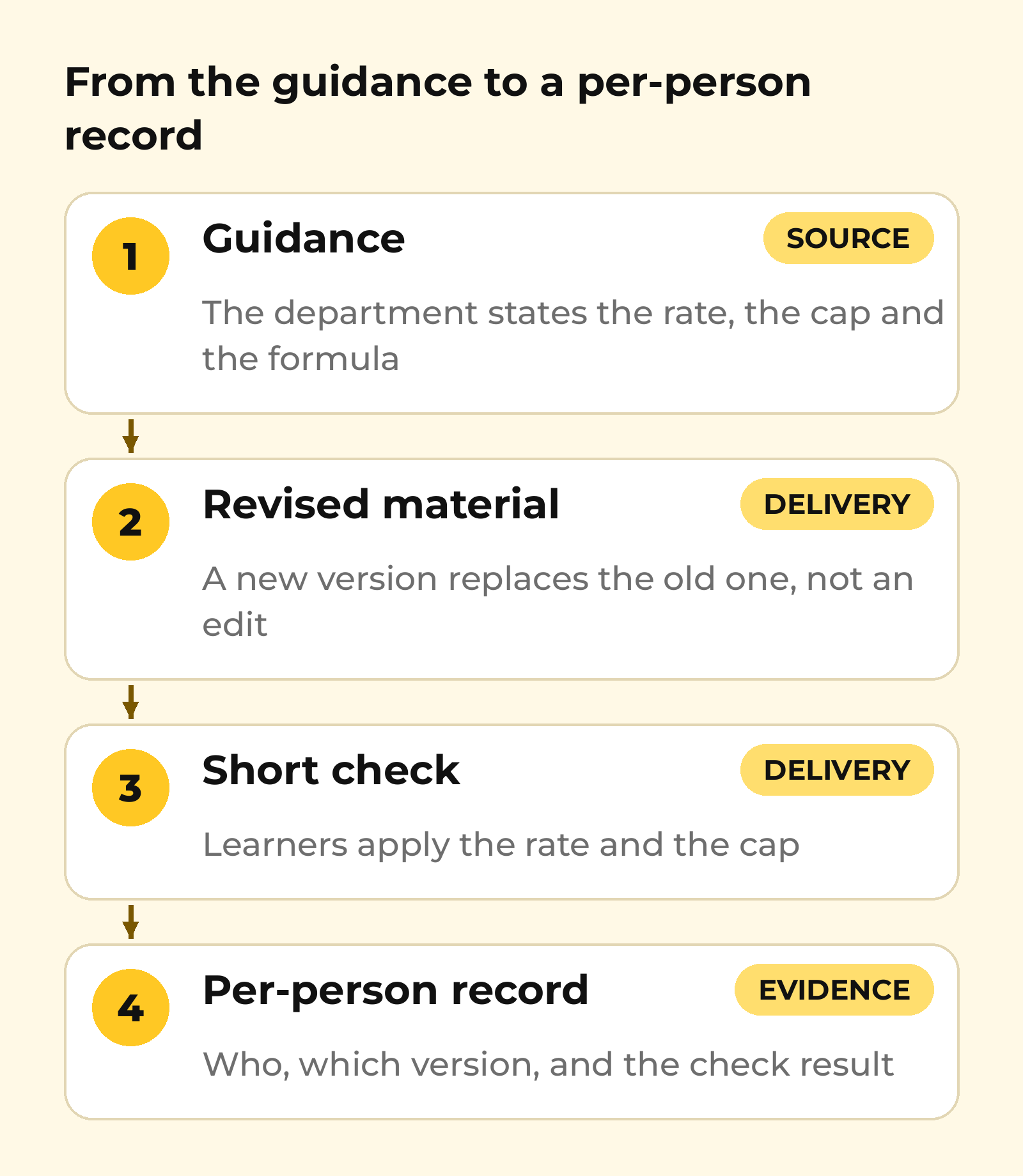
That chain is ordinary training operations, not a compliance invention. The guidance-based content is written once; the revised material replaces the old version; a short check confirms the learner can apply the rate and the cap; and a record ties the person to the version, the check result and the completion date. The failure mode is a break anywhere in the middle: material updated but nobody re-briefed, or people re-briefed from a deck whose worked examples still use $42.1, or everyone briefed and nothing kept.
For a group with more than one entity, the break is usually in the version. In that kind of group, a holding company updates the deck, one subsidiary’s HR uses the group version, and another subsidiary’s operations manager still has the file a former colleague sent two years earlier. Two years later nobody can say which version any particular supervisor saw, and the question “was this person told?” becomes unanswerable even though the answer is probably yes.
Retraining decisions that follow from a rate change
Not every change requires the same response. A rate movement of one dollar is not a reason to rebuild a leadership programme. It is a reason to ask three questions about each existing course that touches pay, hours or attendance, and to answer them with the same discipline used for any other compliance training.
Does the course contain the figures? If it quotes the rate, the cap, a worked example or an old threshold, the content has changed. If it only describes the principle, nothing has changed, and retraining everyone is unnecessary work that also weakens the signal that a re-brief matters.
Who makes the decision the course describes? In most companies that is a small population: shift supervisors, duty managers, schedulers, and the HR staff who answer questions about pay. Retraining that group, thoroughly, is more valuable than a mass course that reaches everyone at low attention.
What would show that a person can now apply the rule? A short scenario check does more than a slide with the new number on it: an employee worked 208.75 hours in the wage period, what is the minimum wage, and does the $17,600 cap change the answer? Two questions of that shape separate people who have understood the structure from people who have memorised one figure.
The operational need here is narrow and specific, and it is worth stating before naming any software. A rate change produces a burst of short, high-stakes briefings for a defined population; the material must be replaced, not edited in place under people who have already taken it; and the result must be a per-person record that still makes sense a year later, when the next change arrives and someone asks what happened last time.
UpLearn supports that in three places. Completion is checked against criteria set for each course, automatically, after each learning activity (capability R-01), so a briefing followed by a short assessment produces a completion status without anyone chasing a spreadsheet. Once a course has been accessed by learners, its modules can no longer be edited or deleted (capability R-06), which is why a new rate should mean a new version rather than a quiet edit: the version people completed stays the version their record points to. And key administrative actions, including manual adjustments and bulk changes, are recorded in an operation log that can be exported for a chosen period (capability S-01), which answers the question that tends to arrive late: who changed these records, when, and from where.
None of that is a substitute for reading the guidance, and none of it replaces the one instruction worth giving at the end. A platform can hold the version and the evidence; it cannot decide whether the waiting time in a guard’s shift counts as hours worked, and this article does not settle that question either: it depends on the contract, the agreement with the employee and the arrangements at the site, which is where advice beyond the department’s guidance belongs.
Before the next payroll cycle closes
Four steps, in this order, and none of them needs more than an afternoon.
- Search the courses and briefings that mention pay, hours or attendance for the four figures that matter and the two that have been replaced: $43.1, $17,600, $42.1 and $17,200. Anything that still quotes the old pair is either replaced with a new version, with the people who completed the old one re-enrolled, or retired.
- Confirm that the people who apply the rule, and not only the people who administer it, are on the list. Shift supervisors and schedulers are usually the gap; HR administrators are usually already covered.
- Write the employer’s chosen method for recording hours worked somewhere a supervisor can find it, because the guidance leaves the method to the employer and an unwritten method belongs to whoever is on shift.
- Then put the date on the record. A rate that comes round again under the annual review will bring back the same question: who was told, on which version, and when.
Sources
- Labour Department: Concise Guide to Statutory Minimum Wage, edition showing the $43.1 rate and the $17,600 cap from 1 May 2026 (July 2026)
- Labour Department FAQ: The Minimum Wage Ordinance, Cap. 608, basic principles in computing minimum wage
- Labour Department FAQ: Requirement of employers recording the total number of hours worked by employees
- Labour Department FAQ: Hours worked
- Labour Department: Statutory Minimum Wage leaflet, $43.1 per hour from 1 May 2026
Cyberwisdom Asia Ltd. is a Hong Kong provider of learning management systems, CPD compliance software and bespoke courseware, serving 800+ enterprise clients since 1999.
About Cyberwisdom