On this page
- Key takeaways
- The four levels, and what each one actually measures
- Why most dashboards stop at level one
- Design the evaluation before the course
- Leading indicators: the part most teams skip
- The manager is not a distribution channel
- The compliance case is easier — and worth doing properly
- What to put in front of the business
- Where the evidence comes from
- Sources
Ask an L&D team how last quarter went and you will usually get three numbers: completions, hours, and a satisfaction score. All three are accurate. None of them answers the question the finance director is actually asking, which is whether the money changed anything.
The gap is not a reporting problem. It is a design problem that shows up as a reporting problem. If a programme was commissioned without a stated outcome, there is nothing to measure later except activity — so the dashboard fills up with activity. Fixing the measurement means fixing what happens before the course exists.
Written for HR, L&D and business leaders in Hong Kong organisations, including teams whose training has a regulatory or CPD dimension. The method is general; the compliance examples are Hong Kong specific.
The four levels, and what each one actually measures
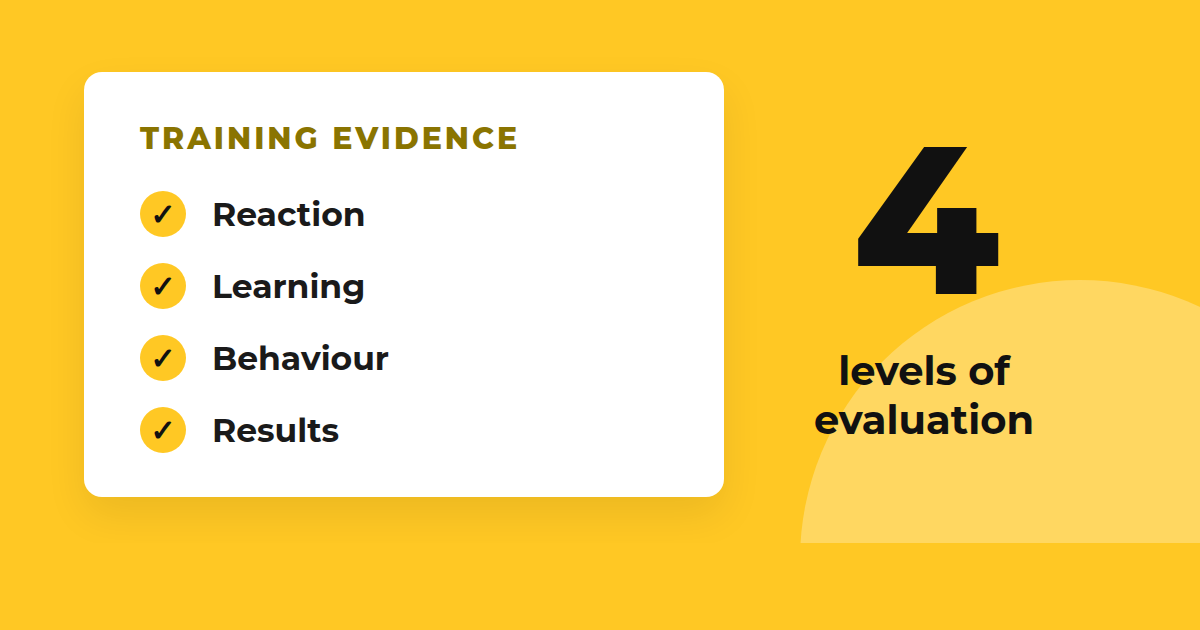
The framework most organisations use sorts evaluation into four levels. It is worth being precise about what each one can and cannot tell you.
| Level | The question | Typical evidence | What it cannot tell you |
|---|---|---|---|
| Reaction | Did participants find it relevant and engaging? | Post-course survey, NPS, facilitator feedback | Whether anyone learned anything or changed anything |
| Learning | Did they acquire the intended knowledge, skills and confidence? | Assessments, scenario tests, observed demonstrations, retrospective self-assessment | Whether it survives contact with the actual job |
| Behaviour | Do they apply it back on the job? | Manager observation, quality audits, call reviews, system data, 30/60/90-day check-ins | Whether the business outcome moved |
| Results | Did the targeted outcomes occur? | The operational metric the programme was commissioned to move | That training alone caused it |
Two things about this table matter more than the levels themselves.
First, the levels are not a ladder you must climb in order — they are four different questions, and a programme can pass one and fail another. A course can be loved, teach nothing, and still be worth running if its purpose was awareness. It can also teach perfectly and change nothing, because the process made the new behaviour impossible.
Second, cost and credibility move in the same direction. Reaction data is cheap and weak. Results data is expensive and contested, because other things move operational metrics too. The honest answer to attribution is not to avoid level four but to collect enough of the levels in between to make the story defensible: if learning happened, behaviour changed in the expected way, and the metric moved in the expected direction at the expected time, “we contributed” is a claim most reasonable executives will accept. “We ran a course and revenue went up” is not.
Why most dashboards stop at level one
Three reasons, and all of them are rational.
Level one and two are inside L&D’s control. You can field a survey and mark an assessment without asking anyone for operational data. Levels three and four require managers, business systems and time — none of which L&D owns.
Levels three and four are slow. A satisfaction score arrives the same day. Behaviour change shows up weeks later, and business results later still. Reporting cycles are monthly; impact is quarterly.
Attribution is uncomfortable. If a programme fails to move the metric, saying so has consequences. It is safer to report activity. The trouble is that a function which cannot say what it changed gets treated as discretionary spend, which is exactly the outcome the caution was meant to avoid.
CIPD’s factsheet on learning evaluation, impact and transfer opens by noting that its research shows practitioners are concerned about measuring the impact of learning, and that effective L&D evaluation must be linked with identified performance gaps. That second clause is the whole method in one sentence: evaluation cannot be retrofitted to a programme that was never tied to a gap.
Design the evaluation before the course
The practical fix is to write the evaluation question at the same time as the objective. Four decisions, made before anything is built:
- Which metric is this programme meant to move? If the answer is “awareness” or “because legal asked”, say so and set the evaluation accordingly — not every programme needs a level four study, and pretending otherwise wastes credibility.
- What does the behaviour look like, and who will see it? Name the observable action and the person or system that would notice it. If nobody would notice, you cannot measure it.
- When will it be checked, and by whom? A date and an owner. “We’ll see how it goes” is not a plan.
- What is the comparison? A pre/post measure, a control group, or a trend against the baseline. Even a simple baseline turns “the number improved” into a defensible claim.
Then triage. CIPD’s factsheet frames evaluation methods as a choice to be made deliberately, and the sensible version of that choice is uneven: deep evaluation for the few programmes where the business needs proof, light-touch monitoring for everything else. Evaluating every course at level four is not a standard, it is a way to ensure nothing gets evaluated properly.
Leading indicators: the part most teams skip
Level four arrives late. Leading indicators tell you in week two whether level four is still plausible — and give you time to intervene.
Pick two or three per programme, observable and countable: number of new-hires completing the first client conversation unsupervised; proportion of cases where the new checklist was used; average time from request to first draft; count of rework items in the first week after rollout. They are behaviour measures wearing a business costume, which is exactly why they are useful: frequent enough to act on, concrete enough to be argued with.
This is also where the learning ecosystem point lands. CIPD’s analysis of how L&D creates value makes the observation that individuals are in L&D’s direct care only for the duration of a course, and that how they continue to apply what they learned back in their teams is often beyond L&D’s control. Leading indicators are how you get visibility into the part you do not control.
The manager is not a distribution channel
The most common failure at level three is not that the training was bad. It is that nobody made room for the new behaviour.
CIPD’s analysis argues that developing skills requires practice, permission and opportunity, and that the line manager is a critical part of the learning ecosystem. Its Learning and skills at work survey found the share of L&D leaders citing lack of manager support as a barrier falling from 29% in 2020 to 23% in 2021 and 19% in 2023 — progress, but manager support still ranks fourth among the barriers standing in the way of L&D progress, behind only learner time, engagement and budget.
CIPD makes a further point worth stealing: it contrasts L&D teams that define their value by learning metrics — attendance, money saved, satisfaction, NPS — with those that define it by business outcomes such as performance, talent and culture. Teams in the second group find manager engagement easier, because they are working on the manager’s own goals rather than asking the manager to adopt L&D’s.
The practical version for a Hong Kong employer: before rollout, tell managers what their people will be trying to do differently, give them one short check-in structure to use, and ask them for one observation at a fixed interval. Three asks, all small, and the difference between a programme with behaviour data and one without.
The compliance case is easier — and worth doing properly
Regulated training has a built-in advantage: the outcome is externally defined. Where a regulator or a professional body says a person must hold a current certificate, or complete a stated number of verifiable hours, effectiveness at the lowest levels is a matter of record rather than interpretation.
That makes the measurable questions concrete: is the certificate current, is the revalidation booked, is the evidence retrievable per person, and can you produce it on request without a week of manual work. Two Hong Kong examples already covered on this site: the expiry and revalidation rules for mandatory safety training, and the verifiable-hours requirements in the HKICPA CPD regime. Both reduce to the same discipline — a record that ties a named person to a dated, evidenced obligation.
The trap is stopping there and reporting compliance completion as if it were capability. Passing a mandatory course proves the certificate exists. It does not prove the person works safely. For high-consequence topics, pair the record with a behaviour measure: observation, incident data, near-miss reports. The same discipline applies where the obligation is newer and less codified: AI literacy training carries no statutory hour count, which makes the evaluation question more important, not less.
What to put in front of the business
A report that opens with completion rates invites the question it cannot answer. Structure it the other way round:
- Start with the gap the programme was commissioned to close, and the metric attached to it.
- State what changed, with the baseline and the interval.
- Show the chain: capability gained, behaviour observed, outcome moved.
- Name the other contributors honestly. Voluntary disclosure of confounding factors buys more credibility than a clean causal claim.
- Say what you will do differently, including what you would cut.
That last item is the one that changes how the function is perceived. A team that recommends stopping something is a team being consulted rather than audited.
Where the evidence comes from
Most of this depends on whether your systems can answer basic questions without a manual exercise. If producing a per-person record of what was completed, when, and what the assessment showed takes a week of spreadsheets, the constraint is not evaluation methodology — it is data. That is a platform question, and how to choose an LMS sets out what to ask about reporting before you commit. For the records themselves, what makes training records audit-ready covers the fields that matter. And if the content needs to reflect your own procedures, equipment or risk scenarios, bespoke courseware is usually a better basis for a behaviour measure than a generic library title.
Sources
- CIPD: Learning evaluation, impact and transfer (factsheet)
- CIPD: Learning needs analysis (factsheet)
- CIPD analysis: how L&D can create value — the role of the line manager
Cyberwisdom Asia Ltd. is a Hong Kong provider of learning management systems, CPD compliance software and bespoke courseware, serving 800+ enterprise clients since 1999.
About Cyberwisdom