On this page
Most training requests arrive already answered. A business leader sees a number going the wrong way, concludes that people need to learn something, and asks for a course. By the time the request reaches L&D, the solution is fixed and the analysis is a formality.
The cost of skipping the analysis is not academic. Training closes knowledge and skill gaps. It does not fix an unclear process, a broken system, a misaligned incentive or a manager who has never been shown how to give feedback. Build a course for one of those and you get completion without change — and a shareholder who concludes, reasonably, that training does not work.
Written for HR, L&D and business leaders in Hong Kong organisations. The method is general; the examples are written for employers who have to justify training spend in a business language their finance team recognises.
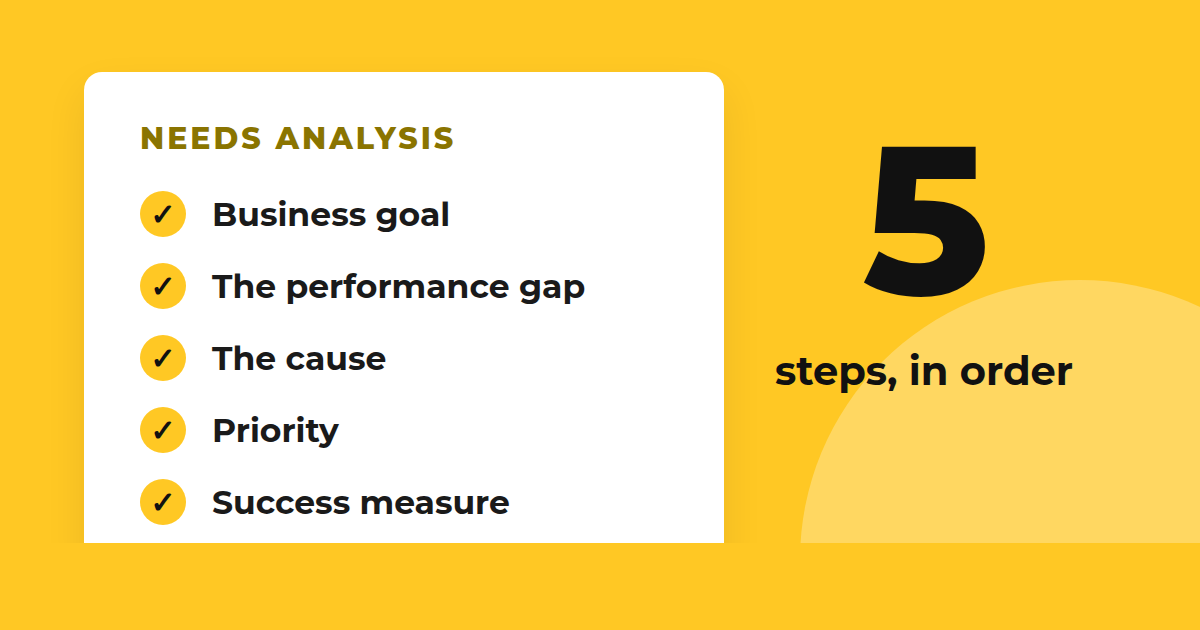
Five steps, in order
1. Define the business goal
Name what the business is trying to change, in a form that already exists somewhere: a revenue target, a quality metric, a complaint rate, a safety incident count, a time-to-competency figure, a compliance obligation. This frames everything after it. Without it, the analysis has no way to say no.
2. Identify the performance gap
Look at the numbers that show the goal is not being met. Sales attainment, first-time-right rates, audit findings, incident rates, average handling time, onboarding ramp time. A gap that shows up in the data is worth investigating; one that only shows up in opinion may not be.
3. Diagnose the cause
This is the step that gets skipped, and it is the one that decides whether the rest is worth doing. For each gap, ask: could these people do the task correctly if they had to? If yes, the constraint is motivation, process, tooling, incentives or unclear expectations — training will not fix it. If no, you have a genuine knowledge or skill gap.
CIPD makes the same point from the other direction: organisations should consider all the appropriate ways to meet a need “rather than defaulting to ‘a course’”.
4. Prioritise and specify
A thorough analysis usually finds more needs than there is budget for, so rank the confirmed ones. Three factors do most of the work:
| Factor | The question it answers |
|---|---|
| Business impact | What happens if this gap stays open for another year? |
| Population size | How many people carry the gap, and are they in critical roles? |
| Regulatory risk | Does leaving this open create a compliance exposure? |
Then specify each priority properly: who the audience is, what they must be able to do afterwards, how it will be delivered, and how success will be measured. If you cannot state the fourth item, the item is not specified yet — and it will be impossible to evaluate later.
5. Validate and reassess
Take the shortlist back to the sponsoring leader before anything is built. This is not a courtesy; it is the point at which priorities get reality-tested against budget and operational capacity. After rollout, use completion data, assessment results and on-the-job evidence to check whether the gap actually closed, then re-run the analysis when the business or the regulatory environment changes.
The three levels, and what each one is for
Analysis at one level cannot substitute for the others.
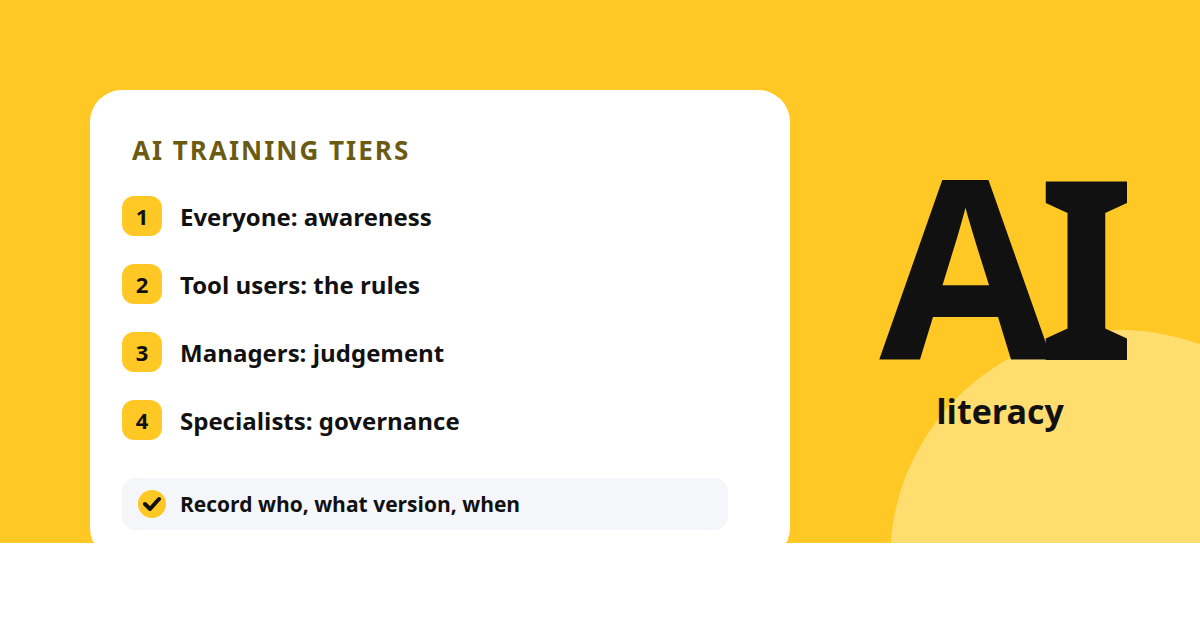
Organisational level asks whether training supports what leadership actually cares about, and where the business is underperforming against those goals. It also surfaces constraints — budget, time, headcount, systems — that decide whether a technically excellent programme can be delivered at all. CIPD notes that needs analysis must flow from business strategy, and that statutory and compliance requirements need to be considered alongside it. A whole-organisation gap such as AI literacy is a strategy question before it is a course question; AI literacy training in Hong Kong shows how that obligation is framed by regulators rather than by statute.
Task or role level breaks the job into the tasks, decisions and behaviours that constitute competent performance. This is the most detailed level and it is what turns into learning objectives and assessment criteria. Without it, content gets selected by what subject matter experts happen to know rather than what learners need to do. Competency frameworks and job analysis with high performers are the practical tools here.
Individual level compares each person’s current capability against the role standard, using appraisal data, manager feedback, observation and assessment. It is the most actionable for a line manager and the most expensive to run at scale. Its real value is in the aggregate: one person’s project management gap is a development conversation; the same gap across most middle managers is a systemic capability issue.
Where the data comes from
No single method is trustworthy alone. CIPD’s factsheet lists the practical sources:
- Organisational data and intelligence — mining what the business already collects is the cheapest starting point.
- Interviews and focus groups with stakeholders, subject matter experts and the impacted employees.
- Informal conversations and attendance at team meetings, which surface things a survey never will.
- Observation of the learner’s real working context — the most accurate for task-level skill, and the most time-consuming.
- Surveys and questionnaires — efficient at scale, but self-assessment skews in both directions, so never let them stand alone.
- Existing systems — LMS and management information showing completion, assessment scores and time-to-competency.
- Competency frameworks, performance management data, and documentation such as job descriptions, work standards and business plans.
Two cautions. The data is sensitive: exposing an individual’s skill gaps needs confidentiality to be respected, or the next round of data will be worthless. And the presence of a gap in the data does not explain its cause — that is step three’s job.
What the output should look like
A needs analysis that ends in a content list has failed. It should end in something like this for each confirmed gap:
- The gap, stated as a difference between required and current capability.
- Why it matters, tied to the business metric from step one.
- Whether training is the right lever — and if not, what is.
- Who is affected, and in what numbers.
- What success looks like, measured how, by when.
- Priority, with the reason stated.
That last field is the one that gets used. Six months later, when a budget line is challenged, “high impact, 40 people, regulatory exposure” is a reason; “we put it in the plan” is not.
Turning the analysis into learning
Once a gap is confirmed and prioritised, the design question is which format closes it fastest without over-building. Not every gap needs a course: a checklist, a worked example, a job shadow or a changed form sometimes closes it better. Where a course is right, the needs analysis output is already most of the design brief — the audience, the observable behaviour, the assessment and the success measure.
If the content needs to reflect your own policies, products, equipment or risk scenarios, that is where bespoke courseware is usually a better fit than a generic library title; the trade-off is set out in off-the-shelf versus custom e-learning. And if you are choosing or replacing the system that will hold the skills data and the evidence, how to choose an LMS lists the questions worth asking about reporting specifically.
Sources
Cyberwisdom Asia Ltd. is a Hong Kong provider of learning management systems, CPD compliance software and bespoke courseware, serving 800+ enterprise clients since 1999.
About Cyberwisdom